
Table of Contents
Scalp micropigmentation and hair transplants age very differently over time. This article compares long-term appearance, maintenance, visual density, and predictability between SMP and hair transplants, helping readers understand which option produces more consistent cosmetic outcomes as hair loss progresses.
Scalp micropigmentation (SMP) and hair transplantation are often presented as competing solutions for hair loss. Early comparisons usually focus on immediacy, coverage, or density. What is discussed far less — and often misunderstood — is how each option looks over time.
Initial results can be misleading. Both SMP and hair transplants change as the years pass, and those changes are driven by very different biological and aesthetic factors. Understanding how each option ages visually is critical for setting realistic expectations.
This article compares the long-term appearance of SMP versus hair transplants, focusing on how each holds up in everyday life rather than how they look in promotional images.
For a complete overview of how scalp micropigmentation results behave overall, see:
scalp micropigmentation results → https://hairtattoo.ca/scalp-micropigmentation-results/
The Core Difference: Illusion vs. Living Hair
The most important distinction between SMP and hair transplantation is not technique — it’s what the viewer is actually seeing.
This difference defines how each option behaves visually over time.
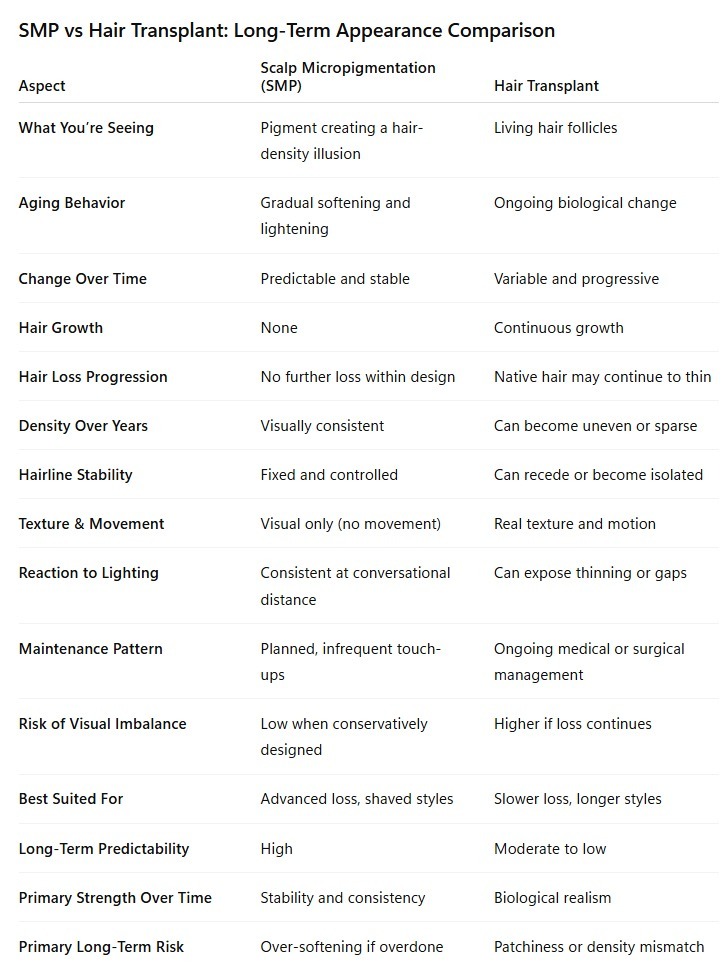
Table of Contents
The most important distinction between SMP and hair transplantation is not technique — it’s what the viewer is actually seeing.
This difference defines how each option behaves visually over time.
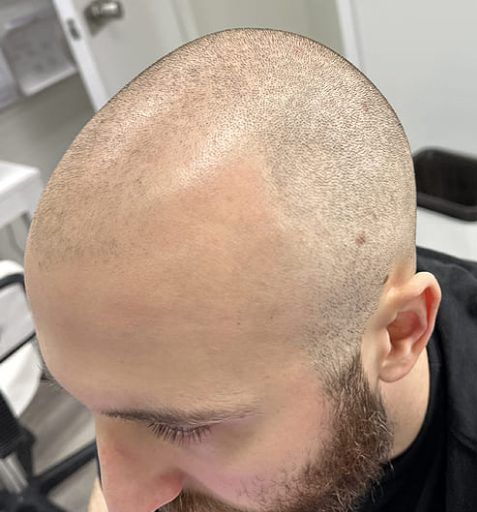
SMP does not grow, shed, or thin. Instead, it changes subtly through:
When designed conservatively, SMP tends to:
Its primary strength long-term is stability. The illusion may soften, but it does not fundamentally change shape or distribution.
Hair transplants involve living hair, which means they are subject to:
Over time, this can result in:
A transplant that looks natural at year one may look very different at year ten if surrounding hair continues to recede.
SMP density is visual, not physical. It does not increase or decrease dramatically unless altered intentionally.
Over time:
Transplanted hair density can change as:
This can lead to areas that appear sparse despite technically successful graft survival.
SMP hairlines are fixed by design.
Advantages:
Limitations:
Transplant hairlines grow and age with the individual.
Advantages:
Limitations:
Long-term realism depends heavily on how well the hairline was planned for future loss.
In everyday conditions, lighting and movement matter more than close-up photos.
Neither option is immune to scrutiny, but each fails in different ways.
SMP maintenance is usually infrequent and subtle:
Maintenance is predictable and typically planned.
Hair transplants often require:
Visual maintenance is often reactive rather than planned.
SMP may hold a more stable appearance when:
In these cases, SMP avoids the patchiness and imbalance that can develop with transplants over time.
Hair transplants may age better when:
In these scenarios, living hair can provide a realism that pigment alone cannot replicate.
Dissatisfaction often stems less from the choice itself and more from misaligned expectations.
People who expect:
are more likely to feel disappointed years later.
Long-term satisfaction improves when the chosen solution aligns with:
Some individuals eventually use both approaches.
Common long-term combinations include:
These approaches acknowledge that hair loss is progressive and that visual strategies may evolve.
Instead of asking:
“Which looks better?”
A more practical question is:
“Which will still look intentional in ten years?”
SMP prioritizes consistency.
Hair transplants prioritize biological realism.
Neither is universally superior — they simply age differently.
Comparing SMP and hair transplants solely by early results misses the most important factor: time.
SMP offers visual stability and predictability. Hair transplants offer real texture and movement but require ongoing consideration as hair loss progresses. Long-term appearance depends less on the procedure itself and more on planning, restraint, and realistic expectations.
Understanding how each option ages allows for better decisions — and fewer surprises — years down the line.

HAIRTATTOO.CA is the No.1 Scalp Micropigmentation clinic in Toronto Canada, offering a revolutionary hair loss solution that has transformed the lives of countless Canadians.
© 2026 HAIRTATTOO.CA | Scalp Micropigmentation & Trichology Centre
